


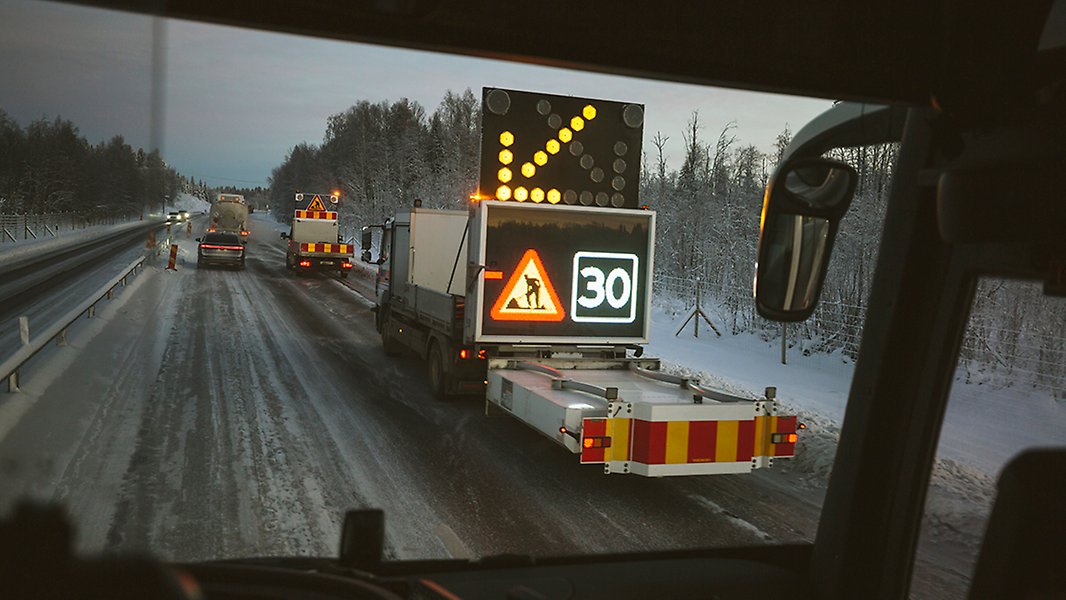
An early warning to the driver can reduce the risk of rear-end collisions at roadworks.
Warns of roadworks before they come into view – RWW is now live
The roadworks are not yet visible, but the car or app already knows they are further ahead and can warn the driver. In a multi-year project, Svevia and BM-System have found a way to use data already available from connected road maintenance vehicles to improve road safety. Road Work Warning (RWW) has now moved from pilot phase to live operation.
Publicerad:
Road maintenance is often carried out using vehicles that travel significantly more slowly than other traffic. This increases the risk of rear-end collisions.
Technology is now available that can warn motorists well in advance of roadworks further ahead along their route.
– A digital warning directly in the car provides an additional layer of protection, as the information reaches the driver before the hazard becomes imminent,” explains Mats Wärme, Project Manager at BM-System.
Apps and vehicles already receiving warnings
In Sweden, it is estimated that a TMA vehicle is struck by another vehicle as often as every five days. The vehicle is designed both to warn of roadworks and to absorb the impact of a collision through its crash protection system. Despite this protection, a collision poses a serious risk to road users, road workers and TMA drivers.
With RWW, digital warnings are sent in real time directly to vehicle navigation systems and apps as drivers approach roadworks or a service vehicle. This gives drivers more time to reduce their speed and adjust their driving before the roadworks become visible.
The warnings are already being delivered in live operation. Škoda vehicles in Sweden and Norway can receive the warnings directly in the car. The information is based on data from approximately 7,000 Swedish and Norwegian road maintenance vehicles, distributed by HAAS Alert through its Safety Cloud® platform. The same warnings also reach navigation apps such as Waze and Apple Maps. BMW has also conducted successful tests together with Bosch and the Swedish Transport Administration.
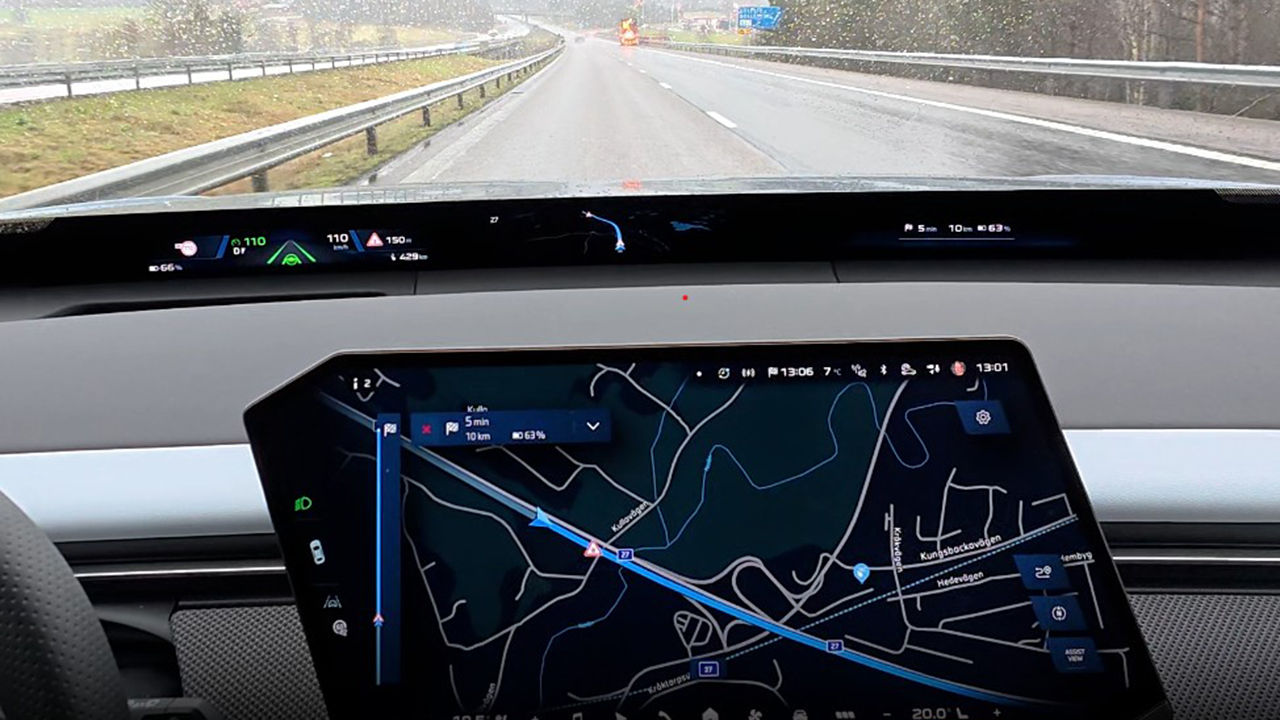
A warning on the car's display makes the driver aware of roadworks further ahead along the route well in advance.
Showcased at an international conference in Gothenburg
The Nordic rollout is part of a broader European deployment. According to HAAS Alert, Safety Cloud® is already delivering warnings from roadworks and emergency response vehicles in the Netherlands, Germany and the United Kingdom. In Belgium, TMA vehicles have also been connected to the platform in what HAAS Alert describes as the second-largest road-related activation in Europe. According to HAAS Alert, the warnings reach thousands of drivers and road workers there every day.

– From the very beginning, our ambition has been greater than 'simply' developing the technical solution. For the technology to make a difference, an entire ecosystem needs to be in place. Road maintenance vehicles need to share their locations, the information must be carefully quality-assured and distributed, and someone must be ready to receive it. We have now reached a point where we can see that all these elements are working, says Mats.
In April this year, the RWW project demonstrated the technology at the international 5GAA conference in Gothenburg. A TMA vehicle operating as part of its regular duties travelled along national road 40. A BMW followed behind and received a real-time warning about the TMA vehicle before its driver could see it.
Demonstration in live traffic conditions
– It was certainly exciting to demonstrate the technology in real-world traffic conditions in front of representatives from across the international automotive and telecommunications industries,” says Andreas Bäckström, who is responsible for the project at Svevia.
A warning on the car's display makes the driver aware of roadworks further ahead along the route well in advance.

– Our basic idea has always been quite simple: to use data that already exists. All information about the locations of road maintenance vehicles is available thanks to GPS and the Swedish Transport Administration's requirements for connected road maintenance vehicles. So it makes sense to use that information to make traffic safer. We have now succeeded in developing the solution on a shared system and can also distribute the information further in a controlled manner.
RWW = Road work warning
- The RWW project is a collaboration involving, among others, the Swedish Transport Administration, the Norwegian Public Roads Administration and a large number of road contractors, app providers and vehicle manufacturers.
- The purpose is to send digital warnings in real time directly to vehicle navigation systems and apps as drivers approach roadworks or a service vehicle.
- The goal is to drastically reduce accidents at roadworks.
- The project is managed and funded by Svevia and BM-System, with support from Vinnova, SBUF and the Swedish Transport Administration.
The next step is to reach more users
The RWW project will conclude in 2027. By then, the next step needs to be in place: a long-term solution for how the system will be operated, funded and maintained, and how it can be extended to municipal roads and more types of vehicles.
The project has recently been awarded SEK 11.5 million by Vinnova to fund work aimed at bringing digital road safety services into actual operation.
The next challenge is to encourage more people to use the service.
– Our focus now is on developing a stable model for how we will continue to collect, quality-assure and distribute safety-critical traffic information to different types of vehicles. Quite simply, how we can make the system even safer and better and, above all, reach many more users. Because the technology works. The project has demonstrated that. What remains is perhaps the biggest challenge of all: ensuring that it is used on the roads,” say Mats and Andreas.
Technology enabling dynamic geofencing
The project also represents a major step towards enabling the introduction of dynamic geofencing, or virtual geographic boundaries. The technology can be used to automatically adjust the speed of connected road users approaching roadworks. Using information from connected road maintenance vehicles, the digital zone can be made dynamic and move at the same pace as the TMA and maintenance vehicles.
The consultancy firm ViaPM has joined the ongoing final implementation project, with Hawzheen Karim serving as Project Manager and Coordinator.
Passing traffic at roadworks
A large proportion of the risks at roadwork sites come from passing traffic. Mobile roadworks, where work is carried out while traffic continues to pass, are particularly vulnerable.
In 2022, 70 collisions involving TMA vehicles, which are used to protect road workers and work sites, were recorded. At least 13 of these were accidents involving personal injuries. In 46 per cent of the collisions, the striking vehicle was a commercial vehicle.
Läs också:


Vårt erbjudande:
Vägunderhåll
Svevia är marknadsledande på vägunderhåll i Sverige och underhåller stora delar av det svenska vägnätet på uppdrag av exempelvis kommuner, trafikverket och privata aktörer.

